

Nursing Exam Prep
Comparison price $7.61$5.99 21% off
↗

Preview is illustrative. The full content is in the downloaded file.
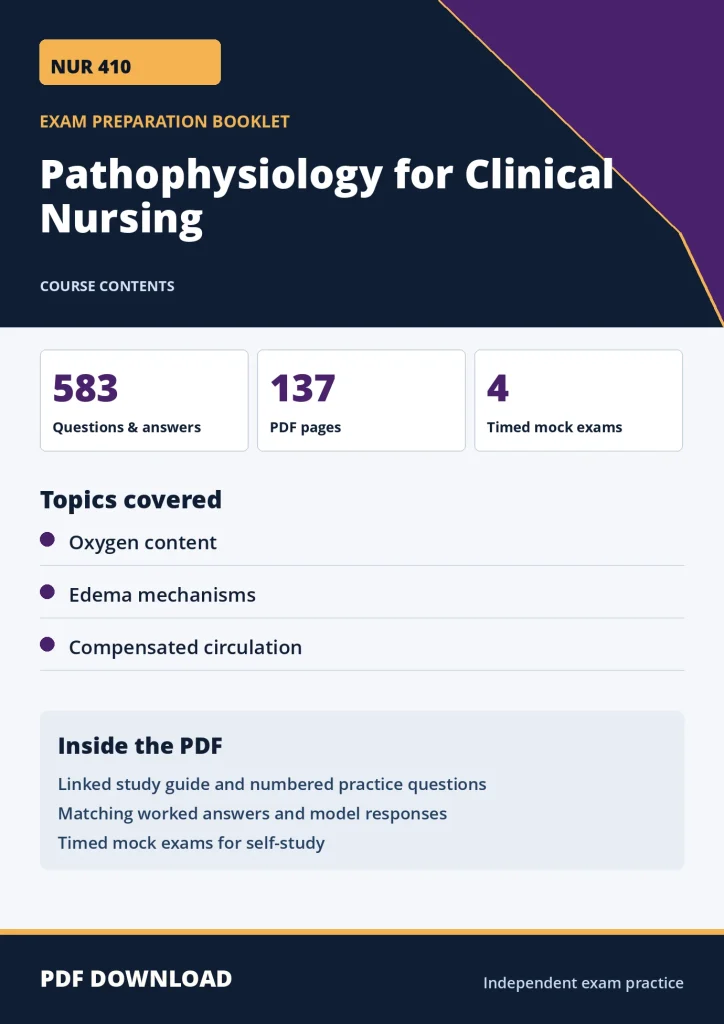
Pathophysiology for Clinical Nursing Exam Preparation Booklet (NUR 410)
- ↓ Instant download
- ↻ Two-sided preview
583 pathophysiology for clinical nursing exam questions and matching worked answers, with 4 timed mocks. Download the 137-page PDF.
Watch the video
See how to find a practice question and its worked answer in the PDF.
This public video is a demonstration. Your paid files are delivered after payment.
You may also like
Browse the shop ↗
Nursing Exam Prep
Comparison price $6.09$4.99 18% off
↗
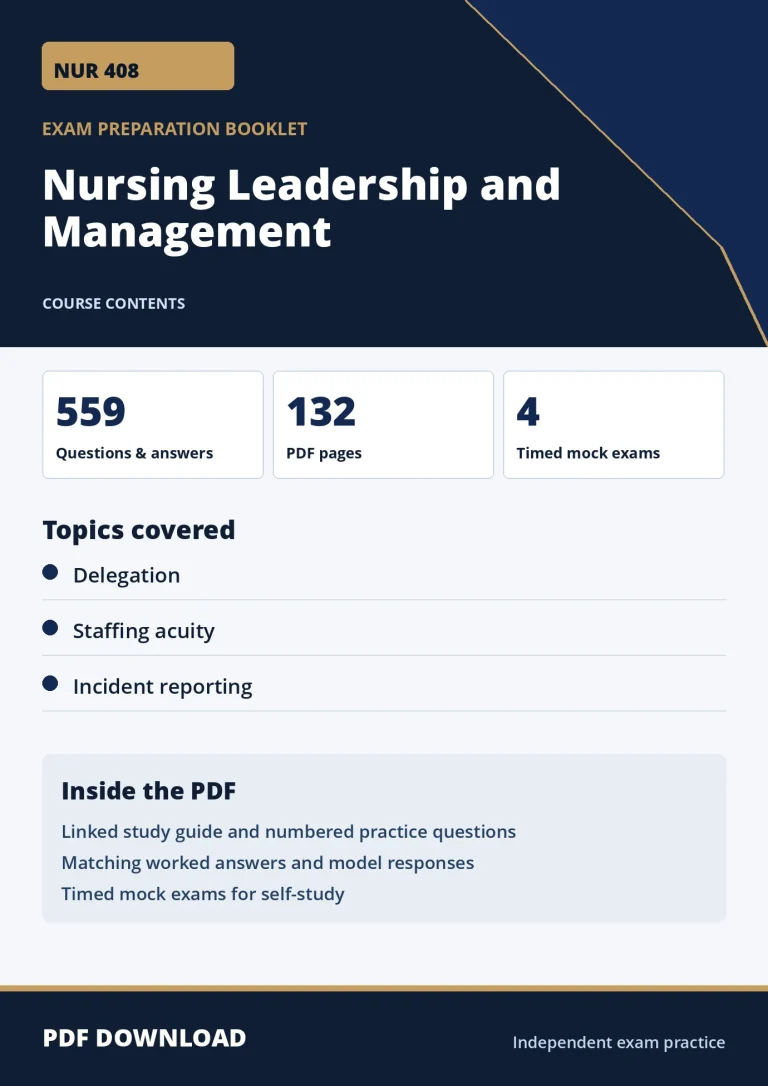
Nursing Leadership and Management Exam Preparation Booklet (NUR 408)

Nursing Exam Prep
Comparison price $8.15$5.99 26% off
↗
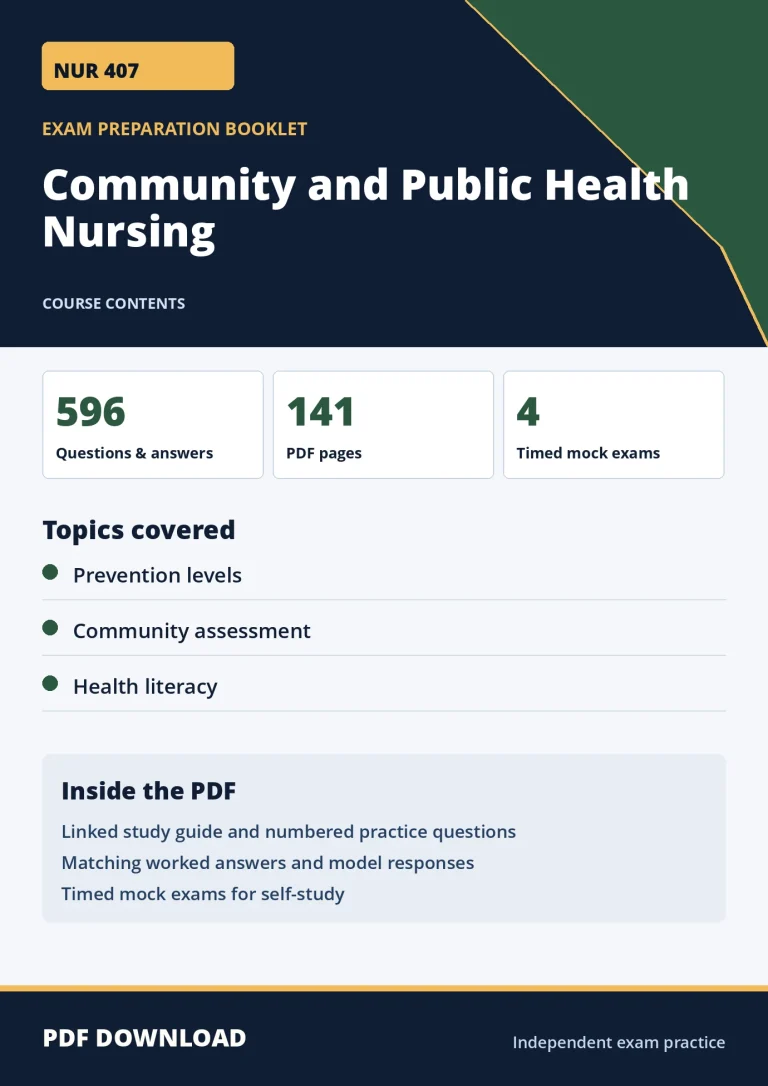
Community and Public Health Nursing Exam Preparation Booklet (NUR 407)
What’s included
- One 137-page PDF booklet
- 583 practice questions and matching answers
- 4 timed mock exams
- Linked study guide
Pathophysiology for Clinical Nursing (NUR 410) is an exam preparation booklet with 583 numbered questions and 583 matching answers in one 137-page PDF. Connect a patient’s presentation to the physiology that could explain it. Trace what affects oxygen delivery, distinguish possible mechanisms of edema, and describe why compensation can make one measurement appear reassuring. The practice covers oxygen content, edema mechanisms, and compensated circulation, along with the other topics listed in the booklet.
Pathophysiology for Clinical Nursing practice topics
- Oxygen content. Hemoglobin falls substantially while oxygen saturation remains unchanged. Saturation is a proportion of occupied binding sites. Total hemoglobin affects oxygen carried.
- Ventilation and carbon dioxide. Alveolar ventilation falls while carbon dioxide production is unchanged. Carbon dioxide elimination depends on alveolar ventilation relative to production.
- Edema mechanisms. Plasma albumin is low and dependent edema develops. Fluid movement also depends on hydrostatic pressure, permeability and lymphatic drainage.
- Renal filtration. A fall in perfusion is followed by a decrease in urine output before serum markers change. Examine time course and alternative causes. Serum creatinine is an indirect and lagging measure.
- Metabolic acid-base change. A primary fall in bicarbonate is accompanied by increased ventilation. Lower carbon dioxide tends to oppose the pH change. Mixed disorders require further assessment.
- Homeostatic feedback. A hormone increases when the substance it normally reduces rises above its set range. The response counteracts the initial disturbance rather than amplifying it.
How to work through the questions
Open the linked study guide on page 2 and go to concepts and short answers on page 3. Answer the first question before using the matching link to open the answer section on page 77. The booklet includes a multiple-choice answer key on page 76 for a quick check. Use the numbered explanations when you want to understand the reasoning or see the workings.
Nursing students can use a scenario to practise writing a priority, the evidence for it, and a concise explanation. In a tutorial, compare how two people interpret the same observations before checking the worked answer.
After a first pass, choose a short set on oxygen content or edema mechanisms. Write your own reasoning before you check the answer. Mark the question numbers you need to repeat. Return to those numbers after reviewing the explanation, then try one of the 4 timed mock exams as a separate practice session. Compare your performance by topic as well as by score so you can choose a useful next revision task.
Preview and download
Use the first public preview to check the course code and question count. The back preview lists the main study topics and the booklet contents. The walkthrough follows a real practice item from the study guide to its worked answer, using pages 3 and 77. It shows the navigation and the page layout you will receive.
The download contains one 137-page PDF, with the illustrated NUR 410 cover, a linked contents page, the question bank, matching worked or model answers, and 4 timed mock exams. Extract the customer ZIP and open the PDF in your preferred reader. You can read it on a phone, tablet, or computer and print selected pages for personal study.
NUR 410 is the course identifier used in this collection. Check the topic list against your syllabus before choosing the booklet.
Prices are shown in USD. DPO Pay charges in Zambian kwacha (ZMW) and shows the converted amount before you pay.
Reviews
4.8 out of 5 · 10 reviews
Adwoa · United Kingdom
Clinical pathophysiology is a sensible starting point for this exam booklet.
Liam · United States
A strong choice for a study block on Pathophysiology for Clinical Nursing. Pair the booklet with notes on disease mechanisms and clinical signs.
Liam · United States
Disease mechanisms and clinical signs give this Pathophysiology for Clinical Nursing review a clear study focus.
Chipo · Australia
Pathophysiology for Clinical Nursing is a sensible choice for a focused study session before the mock exam. Give clinical pathophysiology its own slot.
Chipo · Norway
Clear study direction for Pathophysiology for Clinical Nursing revision.