

Electrical Engineering Exam Prep
Comparison price $5.11$3.99 21% off
↗
Preview is illustrative. The full content is in the downloaded file.
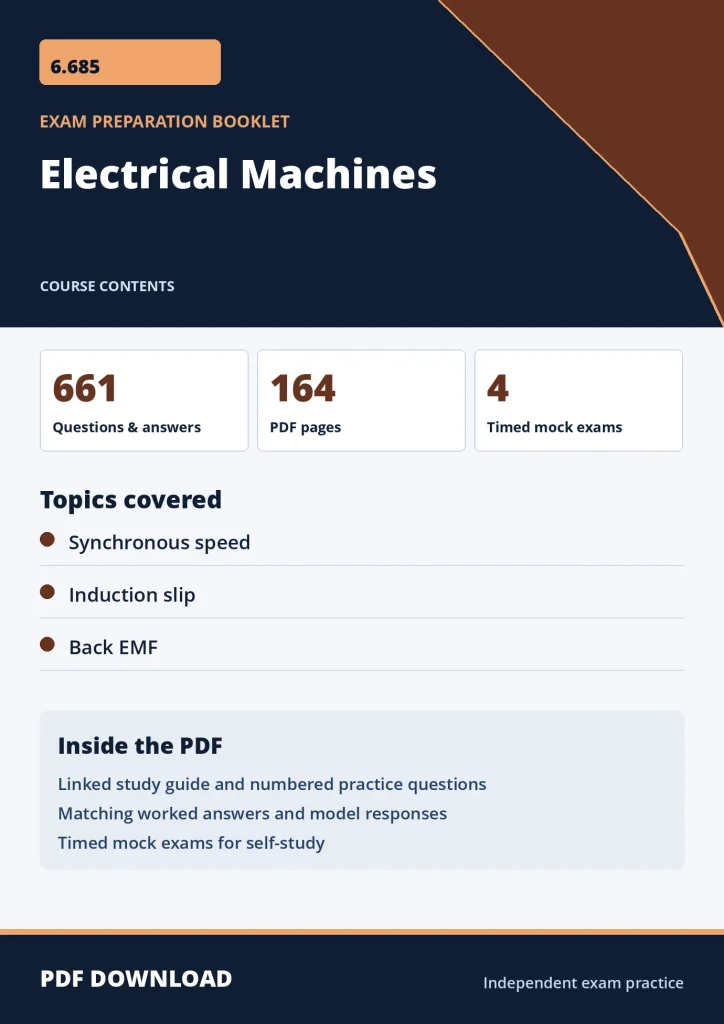
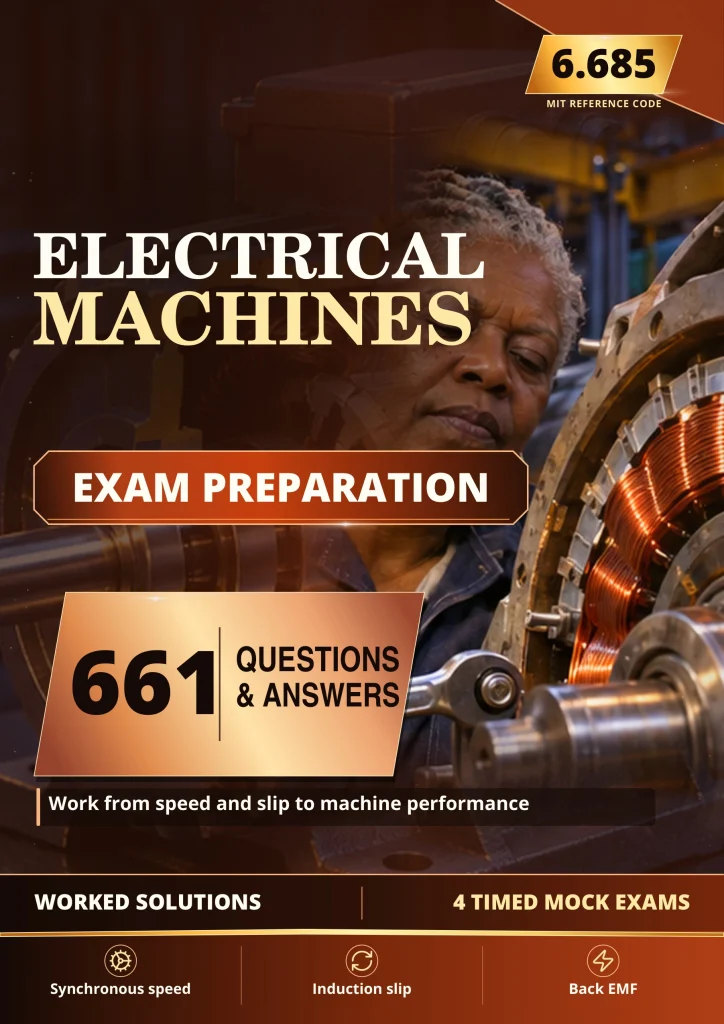
Electrical Machines Exam Preparation Booklet (6.685)
- ↓ Instant download
- ↻ Two-sided preview
661 electrical machines exam questions and matching worked answers, with 4 timed mocks. Download the 164-page PDF.
Watch the video
See how to find a practice question and its worked answer in the PDF.
This public video is a demonstration. Your paid files are delivered after payment.
You may also like
Browse the shop ↗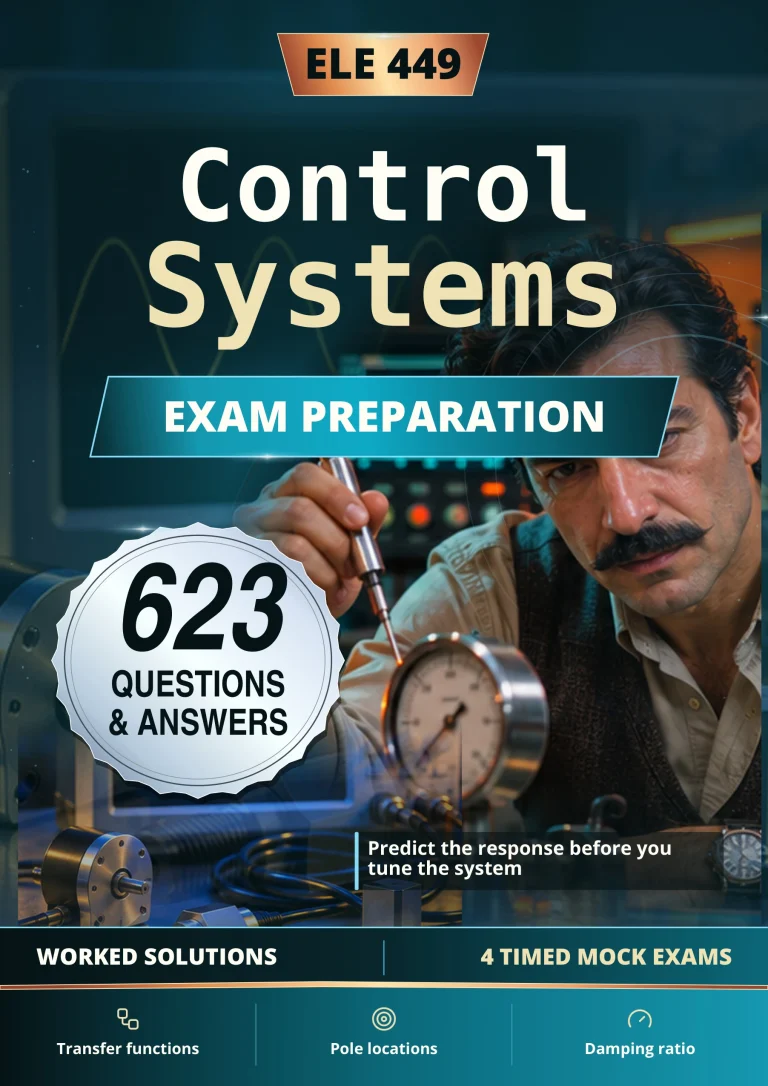
Electrical Engineering Exam Prep
Comparison price $7.37$5.99 18% off
↗
Control Systems Exam Preparation Booklet (ELE 449)
Electrical Engineering Exam Prep
Comparison price $6.59$4.99 24% off
↗
Power Electronics Exam Preparation Booklet (6.622)
What’s included
- One 164-page PDF booklet
- 661 practice questions and matching answers
- 4 timed mock exams
- Linked study guide
Electrical Machines (6.685) is an exam preparation booklet with 661 numbered questions and 661 matching answers in one 164-page PDF. Electrical machines questions link physical operation with calculations. Use speed, slip, induced voltage, and the operating condition to explain why the quantities in a scenario move together or apart. The practice covers synchronous speed, induction slip, and back emf, along with the other topics listed in the booklet.
Electrical Machines practice topics
- Synchronous speed. The frequency and pole count of an AC machine are known. The result is in revolutions per minute for hertz and actual pole count.
- Induction slip. A loaded induction motor runs below synchronous speed. Nonzero motoring slip induces rotor currents in the usual model.
- DC machine torque. Field flux is held constant and armature current rises. Saturation and thermal limits may invalidate simple extrapolation.
- Synchronous excitation. Field excitation changes at fixed real load in a grid-connected synchronous machine. Excitation affects reactive exchange, while mechanical input primarily sets real power.
- Loss separation. A machine’s output falls as load increases despite rising input. Different losses depend on current, flux, speed and temperature.
- Speed control. A variable-frequency drive lowers frequency while voltage remains fixed. In a simplified region, voltage-to-frequency ratio controls flux.
How to work through the questions
Open the linked study guide on page 2 and go to concepts and short answers on page 3. Answer the first question before using the matching link to open the answer section on page 95. The booklet includes a multiple-choice answer key on page 94 for a quick check. Use the numbered explanations when you want to understand the reasoning or see the workings.
Electrical engineering students can keep a line for the units and assumptions before doing the calculation. Then check the sign, the operating point, and whether the result makes sense for the stated circuit or system.
After a first pass, choose a short set on synchronous speed or induction slip. Write your own reasoning before you check the answer. Mark the question numbers you need to repeat. Return to those numbers after reviewing the explanation, then try one of the 4 timed mock exams as a separate practice session. Compare your performance by topic as well as by score so you can choose a useful next revision task.
Preview and download
Use the first public preview to check the course code and question count. The back preview lists the main study topics and the booklet contents. The walkthrough follows a real practice item from the study guide to its worked answer, using pages 3 and 95. It shows the navigation and the page layout you will receive.
The download contains one 164-page PDF, with the illustrated 6.685 cover, a linked contents page, the question bank, matching worked or model answers, and 4 timed mock exams. Extract the customer ZIP and open the PDF in your preferred reader. You can read it on a phone, tablet, or computer and print selected pages for personal study.
The booklet uses 6.685 as a course or exam reference for independent revision. Compare its topics with the syllabus you are preparing for.
Prices are shown in USD. DPO Pay charges in Zambian kwacha (ZMW) and shows the converted amount before you pay.
Reviews
5.0 out of 5 · 20 reviews
Grace · United States
Electrical Machines is a good topic for a separate practice session.
Akosua · Sweden
Solid booklet.
Chipo · Norway
Motors, generators and performance give this Electrical Machines review a clear study focus.
Maya · Ireland
Useful for a focused recap of motors, generators and performance.
Isaac · Norway
Electrical Machines prep makes sense for a session on electrical machinery.