

Public Health Exam Prep
Comparison price $8.27$5.99 27% off
↗

Preview is illustrative. The full content is in the downloaded file.
Advanced Epidemiology Exam Preparation Booklet (PUB 466)
- ↓ Instant download
- ↻ Two-sided preview
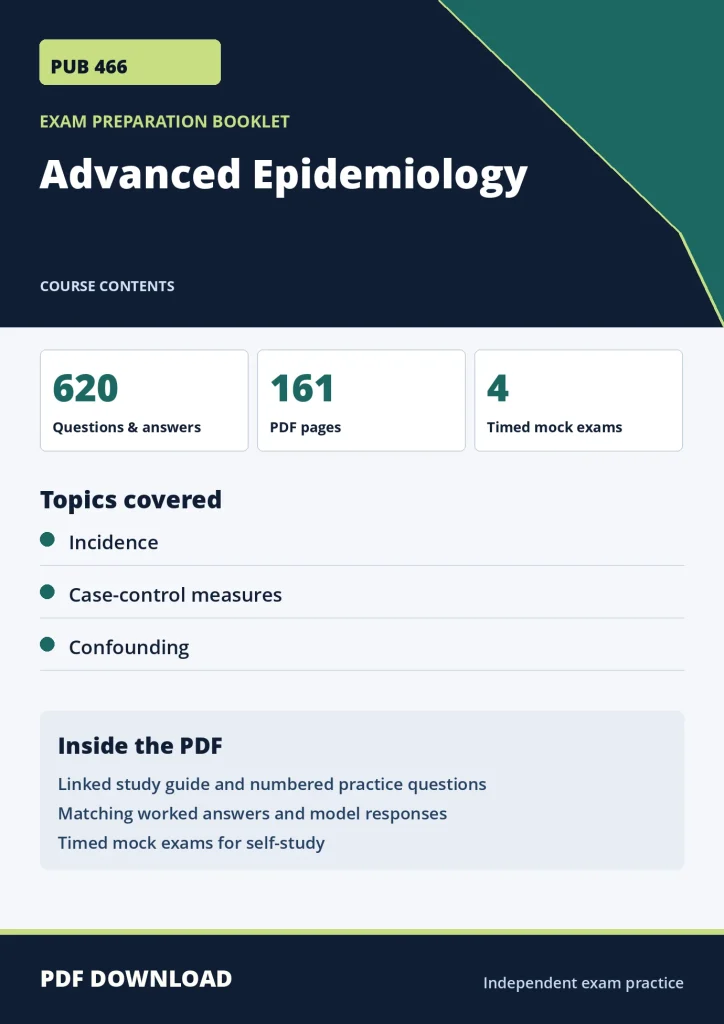
620 advanced epidemiology exam questions and matching worked answers, with 4 timed mocks. Download the 161-page PDF.
Watch the video
See how to find a practice question and its worked answer in the PDF.
This public video is a demonstration. Your paid files are delivered after payment.
You may also like
Browse the shop ↗
Public Health Exam Prep
Comparison price $5.31$3.99 24% off
↗
Health Policy and Management Exam Preparation Booklet (PUB 469)

Public Health Exam Prep
Comparison price $8.95$6.99 21% off
↗
Environmental Health Exam Preparation Booklet (PUB 468)
What’s included
- One 161-page PDF booklet
- 620 practice questions and matching answers
- 4 timed mock exams
- Linked study guide
Advanced Epidemiology (PUB 466) is an exam preparation booklet with 620 numbered questions and 620 matching answers in one 161-page PDF. Epidemiology questions become clearer when the measure follows the study design. Practise choosing the denominator, interpreting an association, and explaining the role of confounding or bias in the result. The practice covers incidence, case-control measures, and confounding, along with the other topics listed in the booklet.
Advanced Epidemiology practice topics
- Cumulative incidence. A closed cohort of disease-free people is followed for one year. The result is a risk over a specified period.
- Incidence rate. Participants contribute unequal times at risk. An incidence rate measures speed of occurrence and has inverse-time units.
- Confounding. An exposure-outcome association changes after stratifying on a common cause. A confounder can mix effects. Assess study design and causal structure before adjusting.
- Selection bias. Follow-up loss is associated with exposure and outcome. Complete-case estimates may differ systematically from the target association.
- Screening comparison. More screened cases survive five years after diagnosis without a change in death rates. Earlier diagnosis can lengthen observed survival without extending life.
- Causal diagram. A variable is a consequence of both exposure and outcome. Conditioning on a common effect can open a biased association path.
How to work through the questions
Open the linked study guide on page 2 and go to concepts and short answers on page 3. Answer the first question before using the matching link to open the answer section on page 93. The booklet includes a multiple-choice answer key on page 92 for a quick check. Use the numbered explanations when you want to understand the reasoning or see the workings.
Public health students can practise stating which population and time period a result refers to. When judging a study or a program, show what the data can support and which conditions could change that interpretation.
After a first pass, choose a short set on incidence or case-control measures. Write your own reasoning before you check the answer. Mark the question numbers you need to repeat. Return to those numbers after reviewing the explanation, then try one of the 4 timed mock exams as a separate practice session. Compare your performance by topic as well as by score so you can choose a useful next revision task.
Preview and download
Use the first public preview to check the course code and question count. The back preview lists the main study topics and the booklet contents. The walkthrough follows a real practice item from the study guide to its worked answer, using pages 3 and 93. It shows the navigation and the page layout you will receive.
The download contains one 161-page PDF, with the illustrated PUB 466 cover, a linked contents page, the question bank, matching worked or model answers, and 4 timed mock exams. Extract the customer ZIP and open the PDF in your preferred reader. You can read it on a phone, tablet, or computer and print selected pages for personal study.
PUB 466 is the course identifier used in this collection. Check the topic list against your syllabus before choosing the booklet.
Prices are shown in USD. DPO Pay charges in Zambian kwacha (ZMW) and shows the converted amount before you pay.
Reviews
4.9 out of 5 · 13 reviews
Linda · Singapore
Useful for a focused recap of study design, bias and risk measures.
Naomi · Philippines
A handy Advanced Epidemiology booklet to pair with class notes on epidemiological methods.
Akosua · Australia
Solid booklet.
Mia · Germany
The Advanced Epidemiology booklet could sit alongside lecture notes for a weekly recap of study design, bias and risk measures.
Samuel · New Zealand
A relevant study aid for Advanced Epidemiology, especially before a mock exam.