
Medicine Exam Prep
Comparison price $5.99$4.99 16% off
↗
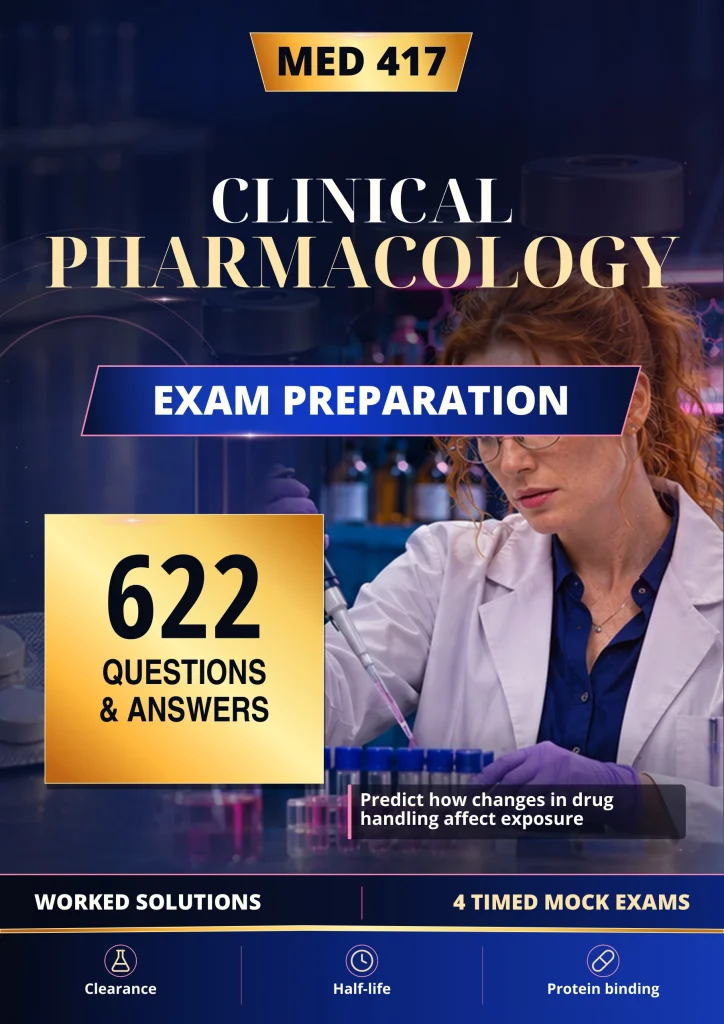
Preview is illustrative. The full content is in the downloaded file.
Clinical Pharmacology Exam Preparation Booklet (MED 417)
- ↓ Instant download
- ↻ Two-sided preview
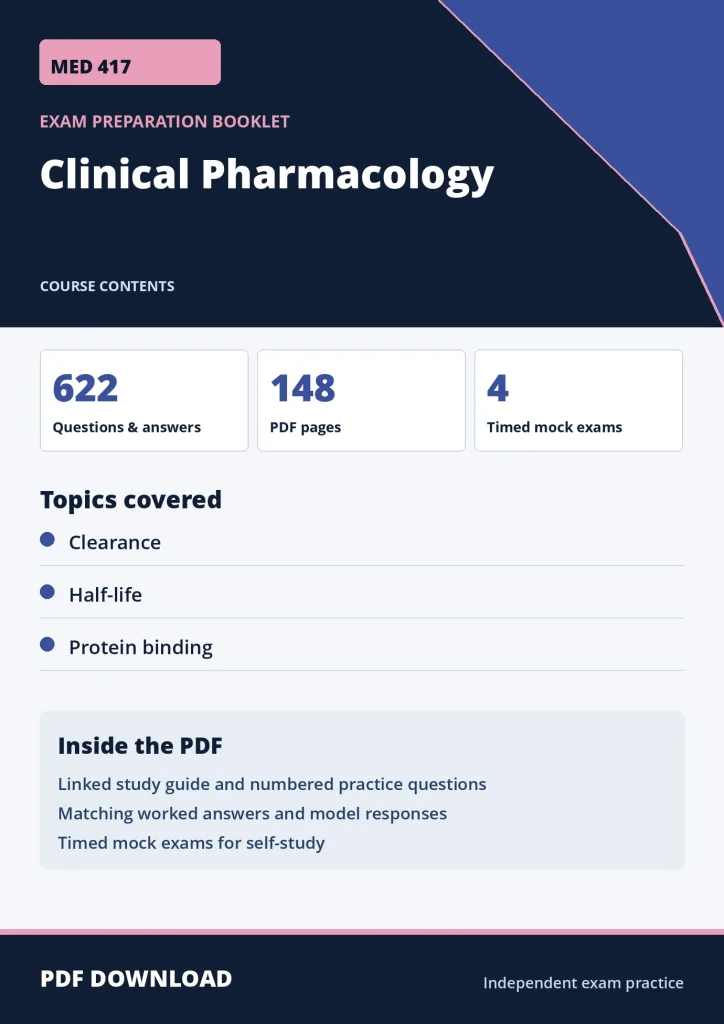
622 clinical pharmacology exam questions and matching worked answers, with 4 timed mocks. Download the 148-page PDF.
Watch the video
See how to find a practice question and its worked answer in the PDF.
This public video is a demonstration. Your paid files are delivered after payment.
You may also like
Browse the shop ↗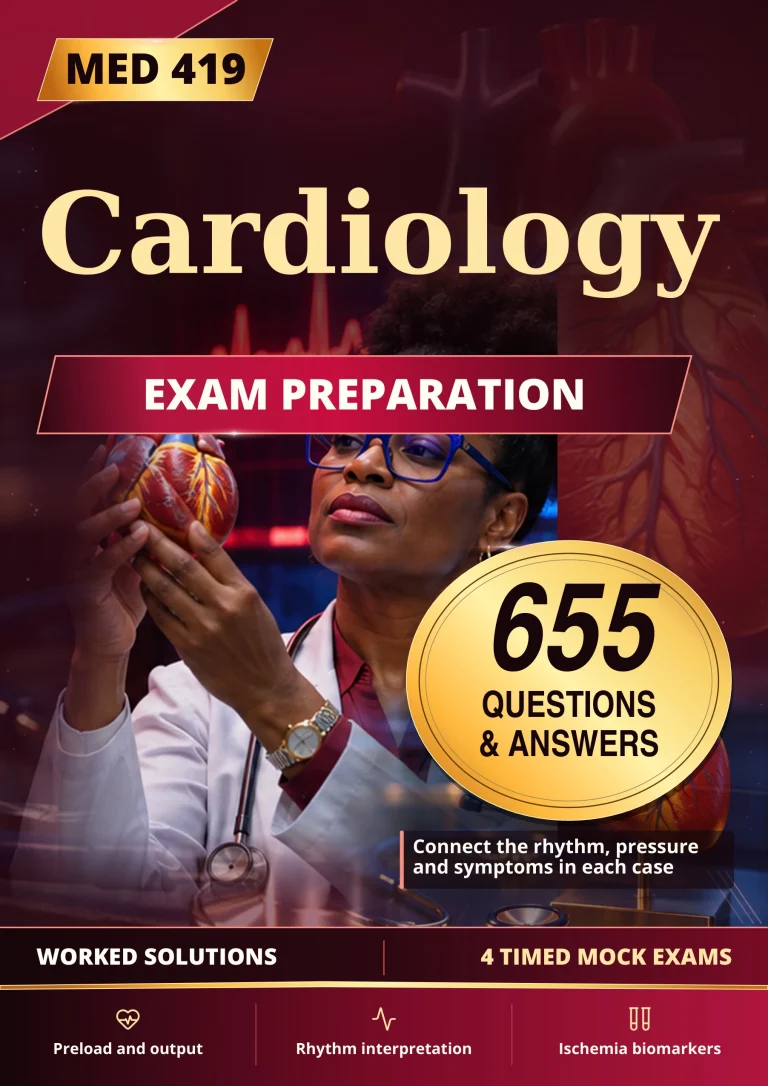
Medicine Exam Prep
Comparison price $9.37$6.99 25% off
↗
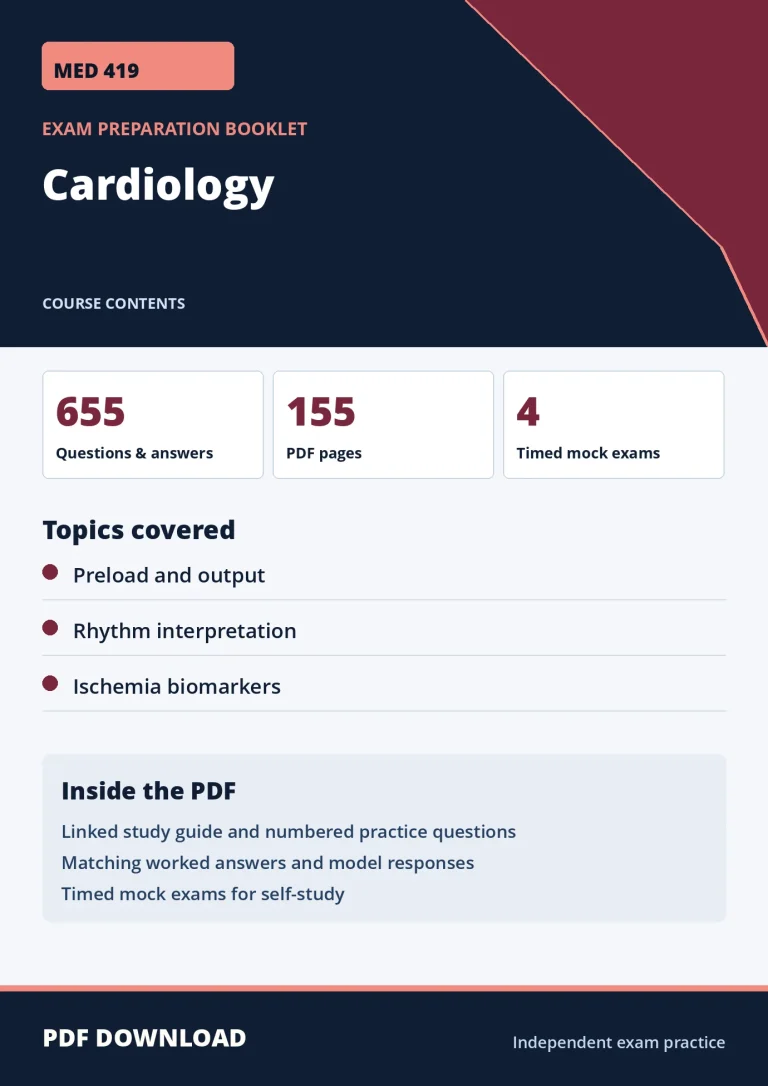
Cardiology Exam Preparation Booklet (MED 419)
Medicine Exam Prep
Comparison price $9.02$6.99 22% off
↗
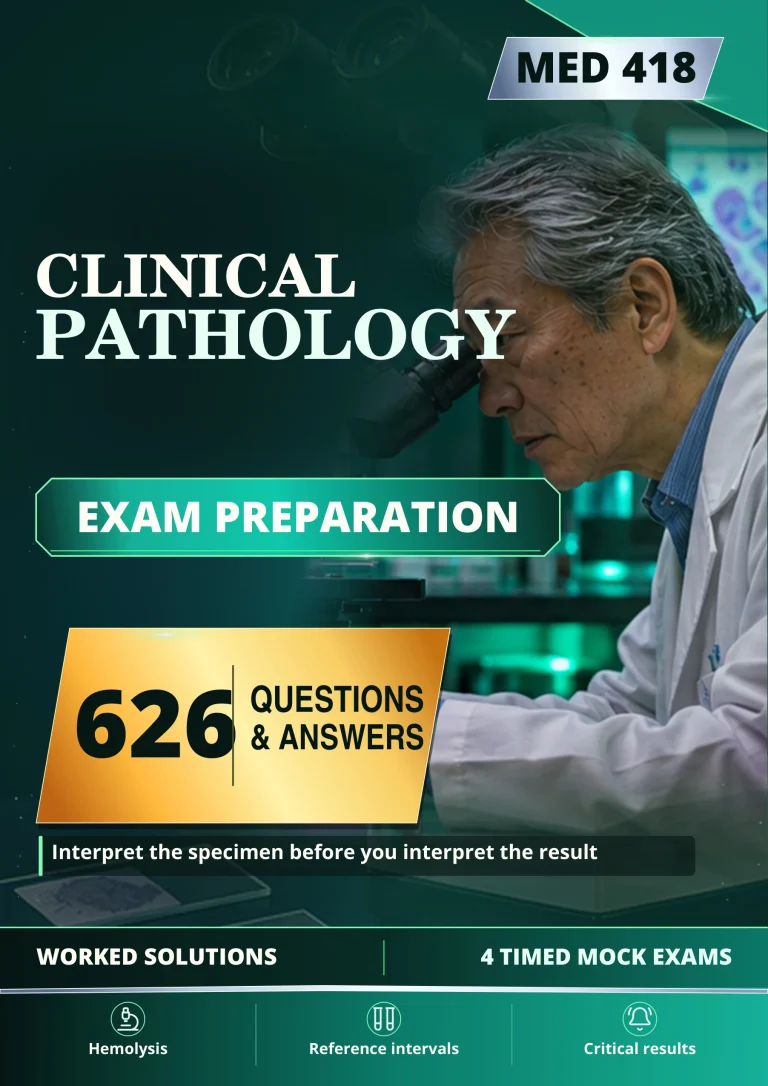
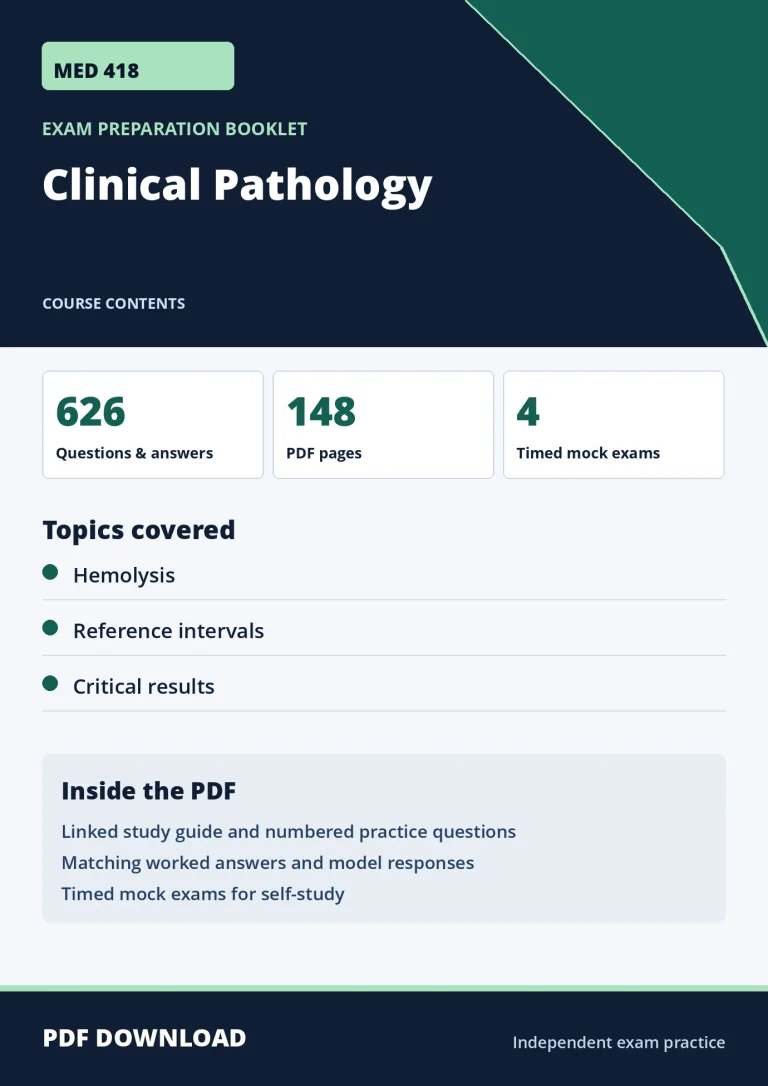
Clinical Pathology Exam Preparation Booklet (MED 418)
What’s included
- One 148-page PDF booklet
- 622 practice questions and matching answers
- 4 timed mock exams
- Linked study guide
Clinical Pharmacology (MED 417) is an exam preparation booklet with 622 numbered questions and 622 matching answers in one 148-page PDF. Build your pharmacology revision around the connection between drug handling and exposure. Practise interpreting changes in clearance, half-life, and binding in the context of the information supplied in each scenario. The practice covers clearance, half-life, and protein binding, along with the other topics listed in the booklet.
Clinical Pharmacology practice topics
- Clearance. A drug’s clearance falls while the same maintenance input rate is continued. At steady state, input equals elimination. Concentration is inversely related to clearance for fixed input.
- Volume of distribution. A medicine partitions extensively into tissues and plasma concentration after distribution is low. Apparent volume relates amount in the body to measured concentration and need not equal anatomical volume.
- Protein binding. A patient’s plasma protein concentration changes for a highly bound medicine. Binding changes can alter the relationship between total and active free concentration.
- Enzyme induction. An inducer is started, and the effect on a susceptible drug develops gradually. Changes in enzyme expression can lag the first or last dose.
- Agonism and antagonism. A reversible competitive antagonist is added in a simple receptor experiment. A simple competitive interaction can shift the concentration-response curve rightward without reducing the maximum.
- Bioavailability. A drug is administered by two routes with different fractions reaching systemic circulation. Bioavailability affects exposure together with clearance and input kinetics.
How to work through the questions
Open the linked study guide on page 2 and go to concepts and short answers on page 3. Answer the first question before using the matching link to open the answer section on page 82. The booklet includes a multiple-choice answer key on page 81 for a quick check. Use the numbered explanations when you want to understand the reasoning or see the workings.
Medical students can practise the reasoning that connects a set of findings with the conclusion requested in a question. Use the case to distinguish findings that support a possibility from findings that would change the next step.
After a first pass, choose a short set on clearance or half-life. Write your own reasoning before you check the answer. Mark the question numbers you need to repeat. Return to those numbers after reviewing the explanation, then try one of the 4 timed mock exams as a separate practice session. Compare your performance by topic as well as by score so you can choose a useful next revision task.
Preview and download
Use the first public preview to check the course code and question count. The back preview lists the main study topics and the booklet contents. The walkthrough follows a real practice item from the study guide to its worked answer, using pages 3 and 82. It shows the navigation and the page layout you will receive.
The download contains one 148-page PDF, with the illustrated MED 417 cover, a linked contents page, the question bank, matching worked or model answers, and 4 timed mock exams. Extract the customer ZIP and open the PDF in your preferred reader. You can read it on a phone, tablet, or computer and print selected pages for personal study.
MED 417 is the course identifier used in this collection. Check the topic list against your syllabus before choosing the booklet.
Prices are shown in USD. DPO Pay charges in Zambian kwacha (ZMW) and shows the converted amount before you pay.
Reviews
4.8 out of 5 · 22 reviews
Mason · France
This is a practical Clinical Pharmacology option for revisiting mechanisms and adverse effects and making a list of topics to practise again.
Daniel · Denmark
Useful as a separate Clinical Pharmacology refresher on drug response.
Ivy · India
Clinical Pharmacology is a sensible choice for a focused study session before the mock exam. Give drug response its own slot.
Liam · France
A handy Clinical Pharmacology booklet to pair with class notes on drug response.
Leah · Netherlands
Mechanisms and adverse effects give this Clinical Pharmacology review a clear study focus.