
Chemical Engineering Exam Prep
Comparison price $5.19$3.99 23% off
↗
Preview is illustrative. The full content is in the downloaded file.
Separation Processes Exam Preparation Booklet (10.32)
- ↓ Instant download
- ↻ Two-sided preview
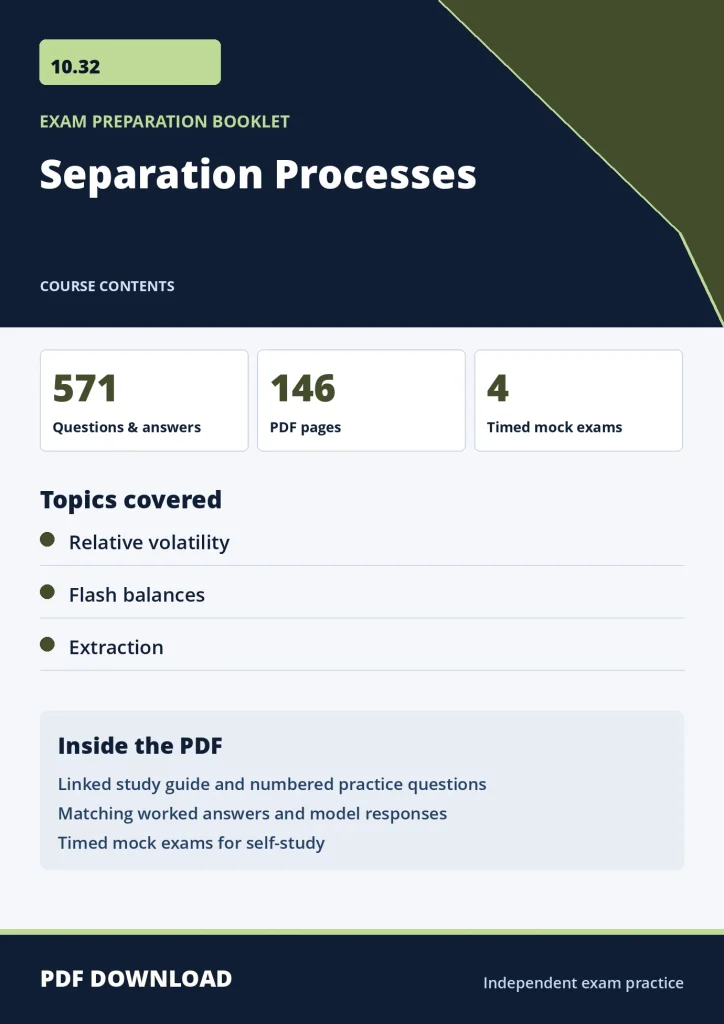
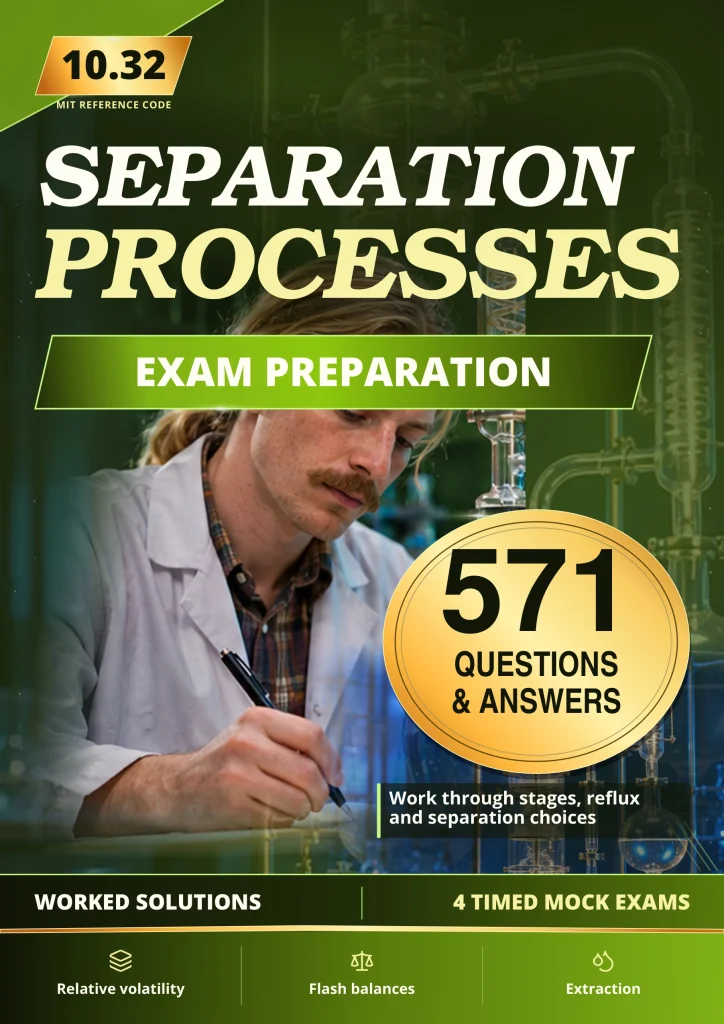
571 separation processes exam questions and matching worked answers, with 4 timed mocks. Download the 146-page PDF.
Watch the video
See how to find a practice question and its worked answer in the PDF.
This public video is a demonstration. Your paid files are delivered after payment.
You may also like
Browse the shop ↗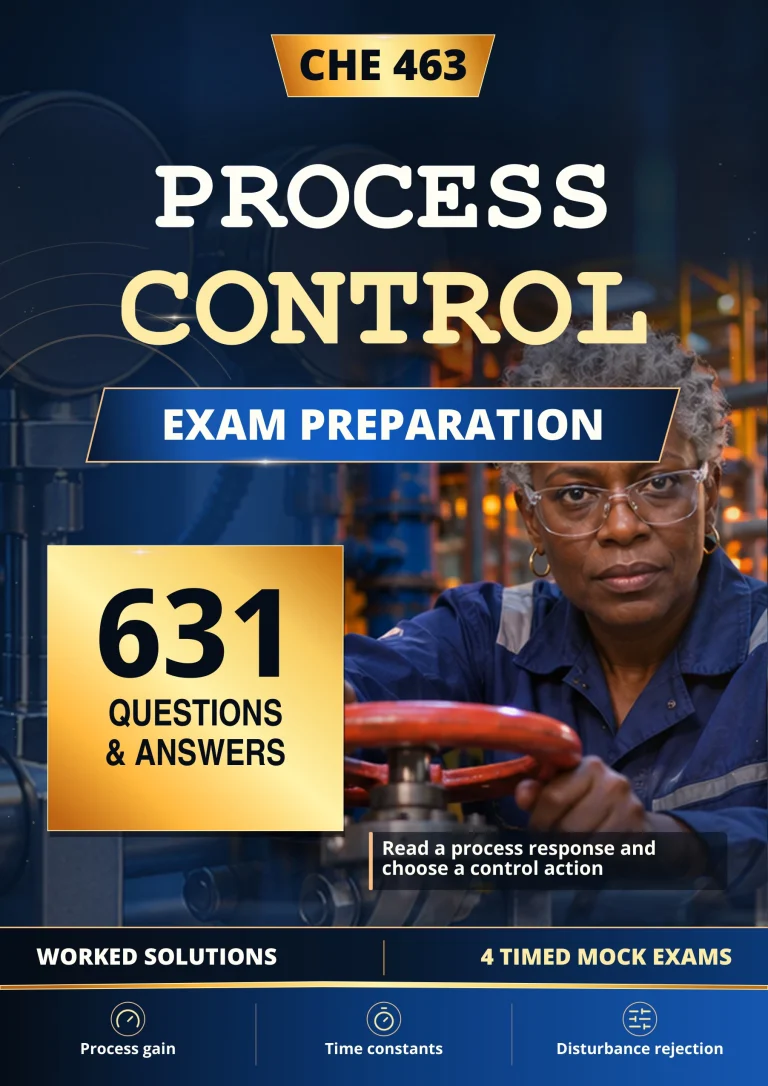
Chemical Engineering Exam Prep
Comparison price $8.39$6.99 16% off
↗
Process Control Exam Preparation Booklet (CHE 463)
Chemical Engineering Exam Prep
Comparison price $5.35$3.99 25% off
↗
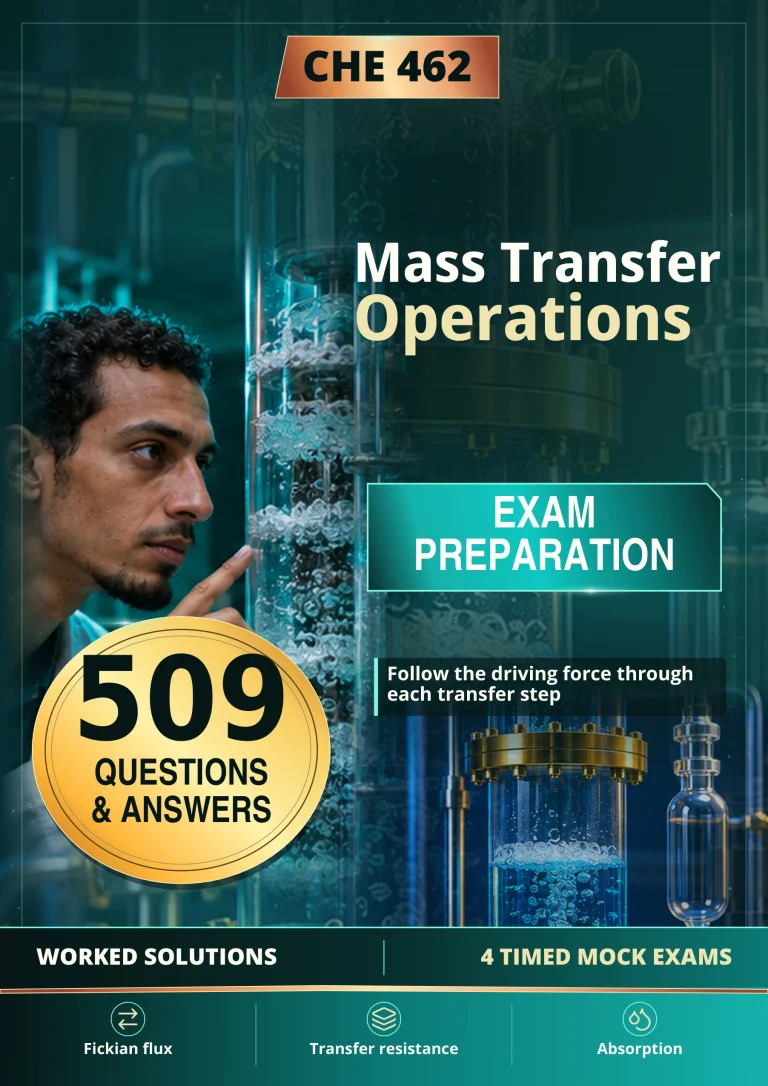
Mass Transfer Operations Exam Preparation Booklet (CHE 462)
What’s included
- One 146-page PDF booklet
- 571 practice questions and matching answers
- 4 timed mock exams
- Linked study guide
Separation Processes (10.32) is an exam preparation booklet with 571 numbered questions and 571 matching answers in one 146-page PDF. Separation processes questions connect phase behavior with the operation chosen to achieve a target. Practise organizing the balance, interpreting volatility, and explaining which condition affects the number or effectiveness of stages. The practice covers relative volatility, flash balances, and extraction, along with the other topics listed in the booklet.
Separation Processes practice topics
- Volatility. Two ideal components have different saturation pressures at one temperature. Vapor composition follows relative volatility and liquid composition under the model.
- Reflux. A column uses more reflux while separation and feed are unchanged. Higher reflux can reduce theoretical stage needs but usually increases utility duty.
- Flash balance. Feed separates into vapor and liquid at equilibrium. An outlet fraction alone does not specify compositions.
- Crystallization. A solution cools and equilibrium solubility falls. Solvent loss, retained solution and purity affect actual recovery.
- Membrane selectivity. A membrane yields a cleaner permeate at lower production rate. Higher selectivity can trade against permeability and energy.
- Energy integration. Hot and cold streams have useful temperature overlap. Temperature feasibility and operating variability matter as well as energy quantity.
How to work through the questions
Open the linked study guide on page 2 and go to concepts and short answers on page 3. Answer the first question before using the matching link to open the answer section on page 87. The booklet includes a multiple-choice answer key on page 86 for a quick check. Use the numbered explanations when you want to understand the reasoning or see the workings.
Chemical engineering students can identify the process boundary, the variables, and the stated model before carrying out a calculation. Use the solution to locate the step where an assumption or a balance changed your result.
After a first pass, choose a short set on relative volatility or flash balances. Write your own reasoning before you check the answer. Mark the question numbers you need to repeat. Return to those numbers after reviewing the explanation, then try one of the 4 timed mock exams as a separate practice session. Compare your performance by topic as well as by score so you can choose a useful next revision task.
Preview and download
Use the first public preview to check the course code and question count. The back preview lists the main study topics and the booklet contents. The walkthrough follows a real practice item from the study guide to its worked answer, using pages 3 and 87. It shows the navigation and the page layout you will receive.
The download contains one 146-page PDF, with the illustrated 10.32 cover, a linked contents page, the question bank, matching worked or model answers, and 4 timed mock exams. Extract the customer ZIP and open the PDF in your preferred reader. You can read it on a phone, tablet, or computer and print selected pages for personal study.
The booklet uses 10.32 as a course or exam reference for independent revision. Compare its topics with the syllabus you are preparing for.
Prices are shown in USD. DPO Pay charges in Zambian kwacha (ZMW) and shows the converted amount before you pay.
Reviews
5.0 out of 5 · 7 reviews
Kwame · Sweden
A useful subject booklet for going over separation methods.
Zara · Ireland
The Separation Processes booklet could sit alongside lecture notes for a weekly recap of distillation and phase equilibria.
Lucas · Australia
Distillation and phase equilibria give this Separation Processes review a clear study focus.
Daniel · Netherlands
A strong study companion for separation methods.
Olivia · France
Separation Processes is a sensible choice for a focused study session before the mock exam. Give separation methods its own slot.